


Canon M100 vs Sigma fp L
The Canon EOS M100 and the Sigma fp L are two digital cameras that were officially introduced, respectively, in August 2017 and March 2021. Both the M100 and the fp L are mirrorless interchangeable lens cameras that are based on an APS-C (M100) and a full frame (fp L) sensor. The Canon has a resolution of 24 megapixels, whereas the Sigma provides 60.2 MP.
Below is an overview of the main specs of the two cameras as a starting point for the comparison.

|
 |

|
|---|---|---|
| Canon M100 | Sigma fp L | |
| Mirrorless system camera | Mirrorless system camera | |
| Canon EF-M mount lenses | Leica L mount lenses | |
| 24 MP – APS-C sensor | 60.2 MP – Full Frame sensor | |
| 1080/60p Video | 4K/30p Video | |
| ISO 100-25,600 | ISO 100-25,600 (6 - 102,400) | |
| No viewfinder, LCD framing | Viewfinder optional | |
| 3.0" LCD – 1040k dots | 3.2" LCD – 2100k dots | |
| Tilting touchscreen | Fixed touchscreen | |
| 6.1 shutter flaps per second | 10 shutter flaps per second | |
| not weather sealed | Weathersealed body | |
| 295 shots per battery charge | 240 shots per battery charge | |
| 108 x 67 x 35 mm, 302 g | 113 x 70 x 45 mm, 427 g |

Check M100 offers at
ebay.com

Check fp L price at
amazon.com
Going beyond this snapshot of core features and characteristics, what are the differences between the Canon EOS M100 and the Sigma fp L? Which one should you buy? Read on to find out how these two cameras compare with respect to their body size, their imaging sensors, their shooting features, their input-output connections, and their reception by expert reviewers.
Body comparison
The physical size and weight of the Canon M100 and the Sigma fp L are illustrated in the side-by-side display below. The two cameras are presented according to their relative size. Three consecutive perspectives from the front, the top, and the back are available. All size dimensions are rounded to the nearest millimeter.
The M100 can be obtained in two different colors (black, white), while the fp L is only available in black.
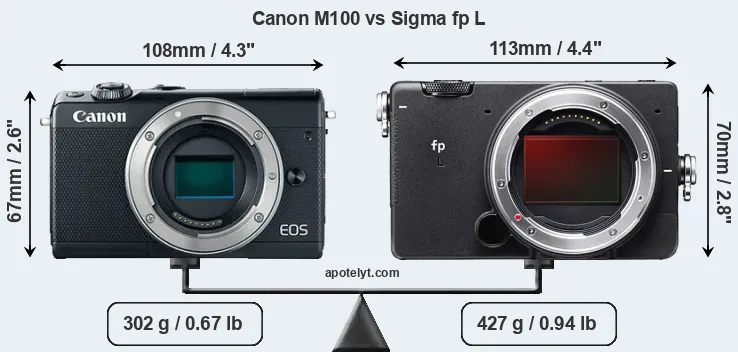

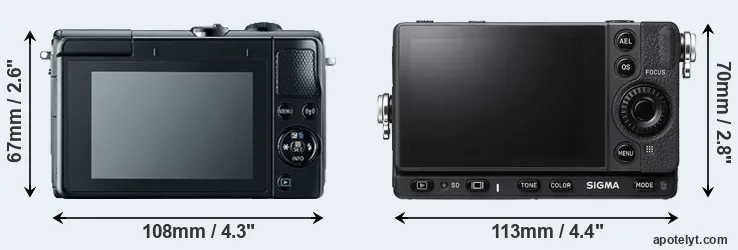
If the front view area (width x height) of the cameras is taken as an aggregate measure of their size, the Sigma fp L is notably larger (9 percent) than the Canon M100. Moreover, the fp L is substantially heavier (41 percent) than the M100. It is noteworthy in this context that the fp L is splash and dust-proof, while the M100 does not feature any corresponding weather-sealing.
The above size and weight comparisons are to some extent incomplete since they do not consider the interchangeable lenses that both of these cameras require. Hence, you might want to study and compare the specifications of available lenses in order to get the full picture of the size and weight of the two camera systems.
Concerning battery life, the M100 gets 295 shots out of its Canon LP-E12 battery, while the fp L can take 240 images on a single charge of its Sigma BP-51 power pack. The power pack in the fp L can be charged via the USB port, which can be very convenient when travelling.
The table below summarizes the key physical specs of the two cameras alongside a broader set of comparators. If you would like to visualize and compare a different camera combination, you can navigate to the CAM-parator app and make your selection from a broad list of cameras there.
|
Camera Model |
Camera Width |
Camera Height |
Camera Depth |
Camera Weight |
Battery Life |
Weather Sealing |
Camera Launch |
Launch Price |
Street Price |
|
|---|---|---|---|---|---|---|---|---|---|---|---|
| 1. | Canon M100 | 108 mm | 67 mm | 35 mm | 302 g | 295 | n | Aug 2017 | US$ 499 | ebay.com | |
| 2. | Sigma fp L | 113 mm | 70 mm | 45 mm | 427 g | 240 | Y | Mar 2021 | US$ 2 499 | amazon.com | |
| 3. | Canon G9 X Mark II | 98 mm | 58 mm | 31 mm | 206 g | 235 | n | Jan 2017 | US$ 529 | ebay.com | |
| 4. | Canon M | 109 mm | 66 mm | 32 mm | 298 g | 230 | n | Jul 2012 | US$ 599 | ebay.com | |
| 5. | Canon M3 | 111 mm | 68 mm | 44 mm | 366 g | 250 | n | Feb 2015 | US$ 679 | ebay.com | |
| 6. | Canon M5 | 116 mm | 89 mm | 61 mm | 427 g | 295 | n | Sep 2016 | US$ 979 | ebay.com | |
| 7. | Canon M6 | 112 mm | 68 mm | 45 mm | 390 g | 295 | n | Feb 2017 | US$ 779 | ebay.com | |
| 8. | Canon M10 | 108 mm | 67 mm | 35 mm | 301 g | 255 | n | Oct 2015 | US$ 499 | ebay.com | |
| 9. | Canon M50 | 116 mm | 88 mm | 59 mm | 390 g | 235 | n | Feb 2018 | US$ 779 | ebay.com | |
| 10. | Canon M200 | 108 mm | 67 mm | 35 mm | 299 g | 315 | n | Sep 2019 | US$ 549 | ebay.com | |
| 11. | Canon SL2 | 122 mm | 93 mm | 70 mm | 453 g | 650 | n | Jun 2017 | US$ 549 | ebay.com | |
| 12. | Canon T7 | 129 mm | 101 mm | 78 mm | 475 g | 500 | n | Feb 2018 | US$ 449 | amazon.com | |
| 13. | Leica M11 | 139 mm | 80 mm | 39 mm | 640 g | 700 | Y | Jan 2022 | US$ 8 999 | amazon.com | |
| 14. | Nikon D780 | 144 mm | 116 mm | 76 mm | 840 g | 2260 | Y | Jan 2020 | US$ 2 299 | amazon.com | |
| 15. | Sigma fp | 113 mm | 70 mm | 45 mm | 422 g | 280 | Y | Jul 2019 | US$ 1 899 | amazon.com | |
| 16. | Sony A7R | 127 mm | 94 mm | 48 mm | 465 g | 340 | Y | Oct 2013 | US$ 2 299 | ebay.com | |
| 17. | Sony A7S | 127 mm | 94 mm | 48 mm | 489 g | 380 | Y | Apr 2014 | US$ 2 499 | ebay.com | |
| Note: Measurements and pricing do not include easily detachable parts, such as add-on or interchangeable lenses or optional viewfinders. | |||||||||||
The price is, of course, an important factor in any camera decision. The retail prices at the time of the camera’s release place the model in the market relative to other models in the producer’s line-up and the competition. The M100 was launched at a markedly lower price (by 80 percent) than the fp L, which puts it into a different market segment. Usually, retail prices stay at first close to the launch price, but after several months, discounts become available. Later in the product cycle and, in particular, when the replacement model is about to appear, further discounting and stock clearance sales often push the camera price considerably down. Then, after the new model is out, very good deals can frequently be found on the pre-owned market.
Sensor comparison
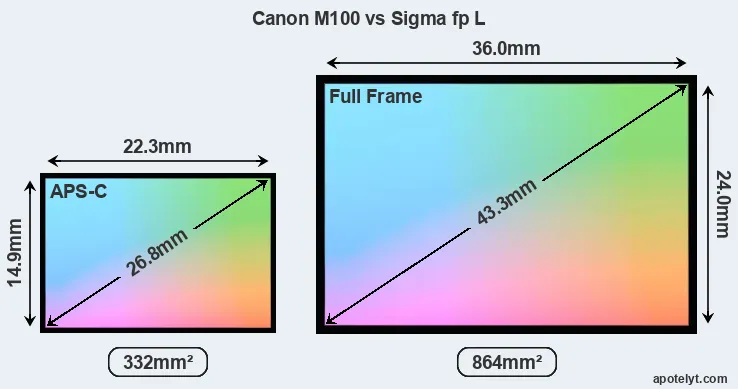
The size of the sensor inside a digital camera is one of the key determinants of image quality. A large sensor will generally have larger individual pixels that offer better low-light sensitivity, provide wider dynamic range, and have richer color-depth than smaller pixels in a sensor of the same technological generation. Furthermore, a large sensor camera will give the photographer more possibilities to use shallow depth-of-field in order to isolate a subject from the background. On the downside, larger sensors tend to be more expensive and lead to bigger and heavier cameras and lenses.
Of the two cameras under consideration, the Canon M100 features an APS-C sensor and the Sigma fp L a full frame sensor. The sensor area in the fp L is 160 percent bigger. As a result of these sensor size differences, the cameras have a format factor of, respectively, 1.6 and 1.0. Both cameras have a native aspect ratio (sensor width to sensor height) of 3:2.
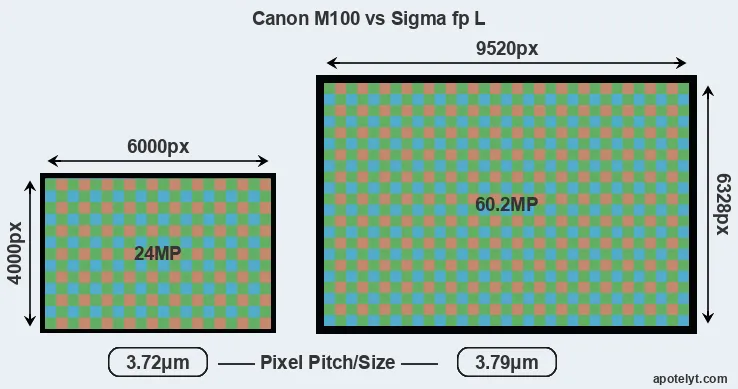
With 60.2MP, the fp L offers a higher resolution than the M100 (24MP), but the fp L nevertheless has marginally larger individual pixels (pixel pitch of 3.79μm versus 3.72μm for the M100) due to its larger sensor. Moreover, the fp L is a much more recent model (by 3 years and 6 months) than the M100, and its sensor will have benefitted from technological advances during this time that further enhance the light gathering capacity of its pixel-units.
The resolution advantage of the Sigma fp L implies greater flexibility for cropping images or the possibility to print larger pictures. The maximum print size of the fp L for good quality output (200 dots per inch) amounts to 47.6 x 31.6 inches or 120.9 x 80.4 cm, for very good quality (250 dpi) 38.1 x 25.3 inches or 96.7 x 64.3 cm, and for excellent quality (300 dpi) 31.7 x 21.1 inches or 80.6 x 53.6 cm. The corresponding values for the Canon M100 are 30 x 20 inches or 76.2 x 50.8 cm for good quality, 24 x 16 inches or 61 x 40.6 cm for very good quality, and 20 x 13.3 inches or 50.8 x 33.9 cm for excellent quality prints.
The M100 has on-sensor phase detect pixels, which results in fast and reliable autofocus acquisition even during live view operation.
The Canon EOS M100 has a native sensitivity range from ISO 100 to ISO 25600. The corresponding ISO settings for the Sigma fp L are ISO 100 to ISO 25600, with the possibility to increase the ISO range to 6-102400.
In terms of underlying technology, the M100 is build around a CMOS sensor, while the fp L uses a BSI-CMOS imager. Both cameras use a Bayer filter for capturing RGB colors on a square grid of photosensors. This arrangement is found in most digital cameras.
Consistent information on actual sensor performance is available from DXO Mark for many cameras. This service is based on lab testing and assigns an overall score to each camera sensor, as well as ratings for dynamic range ("DXO Landscape"), color depth ("DXO Portrait"), and low-light sensitivity ("DXO Sports"). The table below summarizes the physical sensor characteristics and sensor quality findings and compares them across a set of similar cameras.
|
Camera Model |
Sensor Class |
Resolution (MP) |
Horiz. Pixels |
Vert. Pixels |
Video Format |
DXO Portrait |
DXO Landscape |
DXO Sports |
DXO Overall |
|
|---|---|---|---|---|---|---|---|---|---|---|---|
| 1. | Canon M100 | APS-C | 24.0 | 6000 | 4000 | 1080/60p | 23.5 | 12.9 | 1272 | 78 | |
| 2. | Sigma fp L | Full Frame | 60.2 | 9520 | 6328 | 4K/30p | 25.3 | 14.4 | 3001 | 96 | |
| 3. | Canon G9 X Mark II | 1-inch | 20.0 | 5472 | 3648 | 1080/60p | 21.9 | 12.5 | 522 | 65 | |
| 4. | Canon M | APS-C | 17.9 | 5184 | 3456 | 1080/30p | 22.1 | 11.2 | 827 | 65 | |
| 5. | Canon M3 | APS-C | 24.0 | 6000 | 4000 | 1080/30p | 22.8 | 11.8 | 1169 | 72 | |
| 6. | Canon M5 | APS-C | 24.0 | 6000 | 4000 | 1080/60p | 23.4 | 12.4 | 1262 | 77 | |
| 7. | Canon M6 | APS-C | 24.0 | 6000 | 4000 | 1080/60p | 23.4 | 12.6 | 1317 | 78 | |
| 8. | Canon M10 | APS-C | 17.9 | 5184 | 3456 | 1080/30p | 22.2 | 11.4 | 753 | 65 | |
| 9. | Canon M50 | APS-C | 24.0 | 6000 | 4000 | 4K/24p | 23.8 | 13.3 | 1684 | 81 | |
| 10. | Canon M200 | APS-C | 24.0 | 6000 | 4000 | 4k/25p | 24.0 | 13.5 | 1836 | 82 | |
| 11. | Canon SL2 | APS-C | 24.0 | 6000 | 4000 | 1080/60p | 23.6 | 13.4 | 1041 | 79 | |
| 12. | Canon T7 | APS-C | 24.0 | 6000 | 4000 | 1080/30p | 23.8 | 13.3 | 1684 | 81 | |
| 13. | Leica M11 | Full Frame | 60.3 | 9528 | 6328 | none | 26.3 | 14.8 | 3376 | 100 | |
| 14. | Nikon D780 | Full Frame | 24.3 | 6048 | 4024 | 4K/30p | 25.3 | 14.3 | 2877 | 95 | |
| 15. | Sigma fp | Full Frame | 24.0 | 6000 | 4000 | 4K/30p | 25.2 | 14.2 | 2829 | 94 | |
| 16. | Sony A7R | Full Frame | 36.2 | 7360 | 4912 | 1080/60p | 25.6 | 14.1 | 2746 | 95 | |
| 17. | Sony A7S | Full Frame | 12.0 | 4240 | 2832 | 1080/60p | 23.9 | 13.2 | 3702 | 87 | |
| Note: DXO values in italics represent estimates based on sensor size and age. | |||||||||||
Many modern cameras cannot only take still pictures, but also record videos. The two cameras under consideration both have sensors whose read-out speed is fast enough to capture moving pictures, but the fp L provides a better video resolution than the M100. It can shoot movie footage at 4K/30p, while the Canon is limited to 1080/60p.
Feature comparison
Beyond body and sensor, cameras can and do differ across a range of features. The M100 and the fp L are similar in the sense that neither of the two has a viewfinder. The images are, thus, framed using live view on the rear LCD. That said, the fp L can be equipped with an optional viewfinder – the EVF-11. The table below summarizes some of the other core capabilities of the Canon M100 and Sigma fp L in connection with corresponding information for a sample of similar cameras.
|
Camera Model |
Viewfinder (Type or 000 dots) |
Control Panel (yes/no) |
LCD Specifications (inch/000 dots) |
LCD Attach- ment |
Touch Screen (yes/no) |
Max Shutter Speed * |
Max Shutter Flaps * |
Built-in Flash (yes/no) |
Built-in Image Stab |
|
|---|---|---|---|---|---|---|---|---|---|---|---|
| 1. | Canon M100 | none | n | 3.0 / 1040 | tilting | Y | 1/4000s | 6.1/s | Y | n | |
| 2. | Sigma fp L | optional | n | 3.2 / 2100 | fixed | Y | 1/8000s | 10.0/s | n | n | |
| 3. | Canon G9 X Mark II | none | n | 3.0 / 1040 | fixed | Y | 1/2000s | 8.2/s | Y | Y | |
| 4. | Canon M | none | n | 3.0 / 1040 | fixed | Y | 1/4000s | 4.3/s | n | n | |
| 5. | Canon M3 | optional | n | 3.0 / 1040 | tilting | Y | 1/4000s | 4.2/s | Y | n | |
| 6. | Canon M5 | 2360 | n | 3.2 / 1620 | tilting | Y | 1/4000s | 9.0/s | Y | n | |
| 7. | Canon M6 | optional | n | 3.0 / 1040 | tilting | Y | 1/4000s | 9.0/s | Y | n | |
| 8. | Canon M10 | none | n | 3.0 / 1040 | tilting | Y | 1/4000s | 4.6/s | Y | n | |
| 9. | Canon M50 | 2360 | n | 3.0 / 1040 | swivel | Y | 1/4000s | 10.0/s | Y | n | |
| 10. | Canon M200 | none | n | 3.0 / 1040 | tilting | Y | 1/4000s | 6.1/s | Y | n | |
| 11. | Canon SL2 | optical | n | 3.0 / 1040 | swivel | Y | 1/4000s | 5.0/s | Y | n | |
| 12. | Canon T7 | optical | n | 3.0 / 920 | fixed | n | 1/4000s | 3.0/s | Y | n | |
| 13. | Leica M11 | optical | n | 3.0 / 2333 | fixed | Y | 1/4000s | 4.5/s | n | n | |
| 14. | Nikon D780 | optical | Y | 3.2 / 2359 | tilting | Y | 1/8000s | 12.0/s | n | n | |
| 15. | Sigma fp | optional | n | 3.2 / 2100 | fixed | Y | 1/8000s | 12.0/s | n | n | |
| 16. | Sony A7R | 2400 | n | 3.0 / 1230 | tilting | n | 1/8000s | 4.0/s | n | n | |
| 17. | Sony A7S | 2400 | n | 3.0 / 921 | tilting | n | 1/8000s | 5.0/s | n | n | |
| Note: *) Information refers to the mechanical shutter, unless the camera only has an electronic one. | |||||||||||
One difference between the cameras concerns the presence of an on-board flash. The M100 has one, while the fp L does not. While the built-in flash of the M100 is not very powerful, it can at times be useful as a fill-in light.
The M100 has an articulated LCD that can be turned to be front-facing. This characteristic will be appreciated by vloggers and photographers who are interested in snapping selfies. In contrast, the fp L does not have a selfie-screen.The reported shutter speed information refers to the use of the mechanical shutter. Yet, some cameras only have an electronic shutter, while others have an electronic shutter in addition to a mechanical one. In fact, the fp L is one of those camera that have an additional electronic shutter, which makes completely silent shooting possible. However, this mode is less suitable for photographing moving objects (risk of rolling shutter) or shooting under artificial light sources (risk of flickering).
The Sigma fp L has an intervalometer built-in. This enables the photographer to capture time lapse sequences, such as flower blooming, a sunset or moon rise, without purchasing an external camera trigger and related software.
Concerning the storage of imaging data, both the M100 and the fp L write their files to SDXC cards. The fp L supports UHS-II cards (Ultra High Speed data transfer of up to 312 MB/s), while the M100 can use UHS-I cards (up to 104 MB/s).
Connectivity comparison
For some imaging applications, the extent to which a camera can communicate with its environment can be an important aspect in the camera decision process. The table below provides an overview of the connectivity of the Canon EOS M100 and Sigma fp L and, in particular, the interfaces the cameras (and selected comparators) provide for accessory control and data transfer.
|
Camera Model |
Hotshoe Port |
Internal Mic / Speaker |
Microphone Port |
Headphone Port |
HDMI Port |
USB Port |
WiFi Support |
NFC Support |
Bluetooth Support |
|
|---|---|---|---|---|---|---|---|---|---|---|---|
| 1. | Canon M100 | - | stereo / mono | - | - | micro | 2.0 | Y | Y | Y | |
| 2. | Sigma fp L | Y | stereo / mono | Y | Y | micro | 3.2 | Y | - | - | |
| 3. | Canon G9 X Mark II | - | stereo / mono | - | - | micro | 2.0 | Y | Y | Y | |
| 4. | Canon M | Y | stereo / mono | Y | - | mini | 2.0 | - | - | - | |
| 5. | Canon M3 | Y | stereo / mono | Y | - | mini | 2.0 | Y | Y | - | |
| 6. | Canon M5 | Y | stereo / mono | Y | - | mini | 2.0 | Y | Y | Y | |
| 7. | Canon M6 | Y | stereo / mono | Y | - | mini | 2.0 | Y | Y | Y | |
| 8. | Canon M10 | - | stereo / mono | - | - | mini | 2.0 | Y | Y | - | |
| 9. | Canon M50 | Y | stereo / mono | Y | - | micro | 2.0 | Y | - | Y | |
| 10. | Canon M200 | - | stereo / mono | - | - | micro | 2.0 | Y | - | Y | |
| 11. | Canon SL2 | Y | stereo / mono | Y | - | mini | 2.0 | Y | Y | Y | |
| 12. | Canon T7 | Y | mono / mono | - | - | mini | 2.0 | Y | Y | - | |
| 13. | Leica M11 | Y | - / - | - | - | - | 3.2 | Y | - | Y | |
| 14. | Nikon D780 | Y | stereo / mono | Y | Y | mini | 3.1 | Y | - | Y | |
| 15. | Sigma fp | Y | stereo / mono | Y | - | micro | 3.1 | - | - | - | |
| 16. | Sony A7R | Y | stereo / mono | Y | Y | micro | 2.0 | Y | Y | - | |
| 17. | Sony A7S | Y | stereo / mono | Y | Y | micro | 2.0 | Y | Y | - |
It is notable that the fp L has a headphone jack, which makes it possible to attach external headphones and monitor the quality of sound during the recording process. The M100 lacks such a headphone port.
The fp L is a recent model that features in the current product line-up of Sigma. In contrast, the M100 has been discontinued (but can be found pre-owned on ebay). As a replacement in the same line of cameras, the M100 was succeeded by the Canon M200. Further information on the features and operation of the M100 and fp L can be found, respectively, in the Canon M100 Manual (free pdf) or the online Sigma fp L Manual.
Review summary
So what is the bottom line? Is there a clear favorite between the Canon M100 and the Sigma fp L? Which camera is better? A synthesis of the relative strong points of each of the models is listed below.
Advantages of the Canon EOS M100:
- Better live-view autofocus: Features on-sensor phase-detection for more confident autofocus.
- More flexible LCD: Has a tilting screen for odd-angle shots in landscape orientation.
- More selfie-friendly: Has an articulated screen that can be turned to be front-facing.
- Less heavy: Is lighter (by 125g or 29 percent) and hence easier to carry around.
- Longer lasting: Can take more shots (295 versus 240) on a single battery charge.
- Easier fill-in: Is equipped with a small onboard flash to brighten deep shadow areas.
- Easier device pairing: Supports NFC for fast wireless image transfer over short distances.
- Easier wireless transfer: Supports Bluetooth for image sharing without cables.
- More affordable: Was introduced into a lower priced category (80 percent cheaper at launch).
- More heavily discounted: Has been available for much longer (launched in August 2017).
Reasons to prefer the Sigma fp L:
- More detail: Has more megapixels (60.2 vs 24MP), which boosts linear resolution by 59%.
- Better image quality: Is equipped with a larger and more technologically advanced sensor.
- Richer colors: The sensor size advantage translates into images with better, more accurate colors.
- More dynamic range: Larger sensor captures a wider spectrum of light and dark details.
- Better low-light sensitivity: Larger sensor produces good images even in poorly lit environments.
- Better video: Provides higher definition movie capture (4K/30p vs 1080/60p).
- Better sound: Can connect to an external microphone for higher quality sound recording.
- Better sound control: Has a headphone port that enables audio monitoring while recording.
- More framing options: Can be equipped with a hotshoe-mounted accessory-viewfinder.
- Larger screen: Has a bigger rear LCD (3.2" vs 3.0") for image review and settings control.
- More detailed LCD: Has a higher resolution rear screen (2100k vs 1040k dots).
- Faster shutter: Has higher mechanical shutter speed (1/8000s vs 1/4000s) to freeze action.
- Faster burst: Shoots at higher frequency (10 vs 6.1 flaps/sec) to capture the decisive moment.
- Less disturbing: Has an electronic shutter option for completely silent shooting.
- Easier time-lapse photography: Has an intervalometer built-in for low frequency shooting.
- Easier travel charging: Can be conveniently charged via its USB port.
- Better sealing: Is splash and dust sealed for shooting in inclement weather conditions.
- Better lighting: Features a hotshoe and can thus hold and trigger an external flash gun.
- Faster data transfer: Supports a more advanced USB protocol (3.2 vs 2.0).
- Faster buffer clearing: Supports a more advanced SD data transfer standard (UHS-II vs UHS-I).
- More modern: Reflects 3 years and 6 months of technical progress since the M100 launch.
If the number of relative strengths (bullet points above) is taken as a guide, the fp L is the clear winner of the contest (21 : 10 points). However, the relevance of individual strengths will vary across photographers, so that you might want to apply your own weighing scheme to the summary points when reflecting and deciding on a new camera. A professional sports photographer will view the differences between cameras in a way that diverges from the perspective of a street photog, and a person interested in family portraits has distinct needs from a landscape shooter. Hence, the decision which camera is best and worth buying is often a very personal one.
How about other alternatives? Do the specifications of the Canon M100 and the Sigma fp L place the cameras among the top in their class? Find out in the latest Best Mirrorless Interchangeable Lens Camera listing whether the two cameras rank among the cream of the crop.
In any case, while the specs-based evaluation of cameras can be instructive in revealing their potential as photographic tools, it remains partial and cannot reveal, for example, the shooting experience and imaging performance when actually working with the M100 or the fp L. At times, user reviews, such as those published at amazon, address these issues in a useful manner, but such feedback is on many occasions incomplete, inconsistent, and unreliable.
Expert reviews
This is why hands-on reviews by experts are important. The table below provides a synthesis of the camera assessments of some of the best known photo-gear review sites (amateurphotographer [AP], cameralabs [CL], digitalcameraworld [DCW], dpreview [DPR], ephotozine [EPZ], photographyblog [PB]). As can be seen, the professional reviewers agree in many cases on the quality of different cameras, but sometimes their assessments diverge, reinforcing the earlier point that a camera decision is often a very personal choice.
|
Camera Model |
AP score |
CL score |
DCW score |
DPR score |
EPZ score |
PB score |
Camera Launch |
Launch Price |
Street Price |
|
|---|---|---|---|---|---|---|---|---|---|---|---|
| 1. | Canon M100 | 3/5 | + | .. | .. | 4/5 | 3.5/5 | Aug 2017 | US$ 499 | ebay.com | |
| 2. | Sigma fp L | 4/5 | .. | 4/5 | .. | 4/5 | 4/5 | Mar 2021 | US$ 2 499 | amazon.com | |
| 3. | Canon G9 X Mark II | 4/5 | .. | 4/5 | 75/100 | 4.5/5 | 4.5/5 | Jan 2017 | US$ 529 | ebay.com | |
| 4. | Canon M | 3/5 | + | .. | .. | 4/5 | 4/5 | Jul 2012 | US$ 599 | ebay.com | |
| 5. | Canon M3 | 4/5 | o | .. | 75/100 | 4.5/5 | 4/5 | Feb 2015 | US$ 679 | ebay.com | |
| 6. | Canon M5 | 4/5 | + | 4/5 | 82/100 | 4/5 | 4/5 | Sep 2016 | US$ 979 | ebay.com | |
| 7. | Canon M6 | .. | .. | .. | 80/100 | 4/5 | 4/5 | Feb 2017 | US$ 779 | ebay.com | |
| 8. | Canon M10 | .. | .. | .. | .. | .. | 4/5 | Oct 2015 | US$ 499 | ebay.com | |
| 9. | Canon M50 | .. | + | 4/5 | 79/100 | .. | 3.5/5 | Feb 2018 | US$ 779 | ebay.com | |
| 10. | Canon M200 | .. | + | 3/5 | 79/100 | 4/5 | 4/5 | Sep 2019 | US$ 549 | ebay.com | |
| 11. | Canon SL2 | 4/5 | + + | 4/5 | 78/100 | 4.5/5 | 4.5/5 | Jun 2017 | US$ 549 | ebay.com | |
| 12. | Canon T7 | .. | o | 3.5/5 | .. | 3.5/5 | 3.5/5 | Feb 2018 | US$ 449 | amazon.com | |
| 13. | Leica M11 | 4.5/5 | .. | 4.5/5 | .. | 4.5/5 | 4.5/5 | Jan 2022 | US$ 8 999 | amazon.com | |
| 14. | Nikon D780 | 5/5 | .. | 5/5 | 87/100 | 4.5/5 | 4.5/5 | Jan 2020 | US$ 2 299 | amazon.com | |
| 15. | Sigma fp | 4/5 | .. | 4/5 | .. | 4/5 | 4.5/5 | Jul 2019 | US$ 1 899 | amazon.com | |
| 16. | Sony A7R | 5/5 | + + | .. | 82/100 | 4.5/5 | 5/5 | Oct 2013 | US$ 2 299 | ebay.com | |
| 17. | Sony A7S | 4/5 | .. | .. | 86/100 | 4.5/5 | 5/5 | Apr 2014 | US$ 2 499 | ebay.com | |
| Note: (+ +) highly recommended; (+) recommended; (o) reviewed; (..) not available. | |||||||||||
The review scores listed above should be treated with care, though. The assessments were made in relation to similar cameras of the same technological generation. Thus, a score needs to be put into the context of the launch date and the launch price of the camera, and comparisons of ratings among very different cameras or across long time periods have little meaning. It should also be noted that some of the review sites have over time altered the way they render their verdicts.
Check M100 offers at
ebay.com
Check fp L price at
amazon.com
Other camera comparisons
Did this review help to inform your camera decision process? If you would like to see a different side-by-side camera review, just make a corresponding selection in the search boxes below. As an alternative, you can also directly jump to any one of the listed comparisons that were previously generated by the CAM-parator tool.
- Canon M100 vs Canon SX540
- Canon M100 vs Leica Q2
- Canon M100 vs Leica S2
- Canon M100 vs Olympus E-330
- Canon M100 vs Sony A77
- Canon M100 vs Sony A9 II
- Canon M6 Mark II vs Sigma fp L
- Fujifilm GFX 50S II vs Sigma fp L
- Leica CL vs Sigma fp L
- Panasonic S9 vs Sigma fp L
- Samsung NX500 vs Sigma fp L
- Sigma fp L vs Sony A7R IVA
Specifications: Canon M100 vs Sigma fp L
Below is a side-by-side comparison of the specs of the two cameras to facilitate a quick review of their differences and common features.
| Camera Model | Canon M100 | Sigma fp L |
|---|---|---|
| Camera Type | Mirrorless system camera | Mirrorless system camera |
| Camera Lens | Canon EF-M mount lenses | Leica L mount lenses |
| Launch Date | August 2017 | March 2021 |
| Launch Price | USD 499 | USD 2,499 |
| Sensor Specs | Canon M100 | Sigma fp L |
| Sensor Technology | CMOS | BSI-CMOS |
| Sensor Format | APS-C Sensor | Full Frame Sensor |
| Sensor Size | 22.3 x 14.9 mm | 36.0 x 24.0 mm |
| Sensor Area | 332.27 mm2 | 864 mm2 |
| Sensor Diagonal | 26.8 mm | 43.3 mm |
| Crop Factor | 1.6x | 1.0x |
| Sensor Resolution | 24 Megapixels | 60.2 Megapixels |
| Image Resolution | 6000 x 4000 pixels | 9520 x 6328 pixels |
| Pixel Pitch | 3.72 μm | 3.79 μm |
| Pixel Density | 7.22 MP/cm2 | 6.97 MP/cm2 |
| Moiré control | Anti-Alias filter | Anti-Alias filter |
| Movie Capability | 1080/60p Video | 4K/30p Video |
| ISO Setting | 100 - 25,600 ISO | 100 - 25,600 ISO |
| ISO Boost | no Enhancement | 6 - 102,400 ISO |
| DXO Sensor Quality (score) | 78 | .. |
| DXO Color Depth (bits) | 23.5 | .. |
| DXO Dynamic Range (EV) | 12.9 | .. |
| DXO Low Light (ISO) | 1272 | .. |
| Screen Specs | Canon M100 | Sigma fp L |
| Viewfinder Type | no viewfinder | Viewfinder optional |
| LCD Framing | Live View | Live View |
| Rear LCD Size | 3.0inch | 3.2inch |
| LCD Resolution | 1040k dots | 2100k dots |
| LCD Attachment | Tilting screen | Fixed screen |
| Touch Input | Touchscreen | Touchscreen |
| Shooting Specs | Canon M100 | Sigma fp L |
| Focus System | On-Sensor Phase-detect | Contrast-detect AF |
| Manual Focusing Aid | Focus Peaking | Focus Peaking |
| Max Shutter Speed (mechanical) | 1/4000s | 1/8000s |
| Continuous Shooting | 6.1 shutter flaps/s | 10 shutter flaps/s |
| Electronic Shutter | no E-Shutter | up to 1/8000s |
| Time-Lapse Photography | no Intervalometer | Intervalometer built-in |
| Fill Flash | Built-in Flash | no On-Board Flash |
| Storage Medium | SDXC cards | SDXC cards |
| Single or Dual Card Slots | Single card slot | Single card slot |
| UHS card support | UHS-I | UHS-II |
| Connectivity Specs | Canon M100 | Sigma fp L |
| External Flash | no Hotshoe | Hotshoe |
| USB Connector | USB 2.0 | USB 3.2 |
| HDMI Port | micro HDMI | micro HDMI |
| Microphone Port | no MIC socket | External MIC port |
| Headphone Socket | no Headphone port | Headphone port |
| Wifi Support | Wifi built-in | Wifi built-in |
| Near-Field Communication | NFC built-in | no NFC |
| Bluetooth Support | Bluetooth built-in | no Bluetooth |
| Body Specs | Canon M100 | Sigma fp L |
| Environmental Sealing | not weather sealed | Weathersealed body |
| Battery Type | Canon LP-E12 | Sigma BP-51 |
| Battery Life (CIPA) | 295 shots per charge | 240 shots per charge |
| In-Camera Charging | no USB charging | USB charging |
| Body Dimensions |
108 x 67 x 35 mm (4.3 x 2.6 x 1.4 in) |
113 x 70 x 45 mm (4.4 x 2.8 x 1.8 in) |
| Camera Weight | 302 g (10.7 oz) | 427 g (15.1 oz) |
Check M100 offers at
ebay.com
Check fp L price at
amazon.com
Did you notice an error on this page? If so, please get in touch, so that we can correct the information.